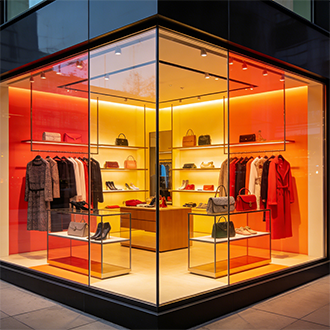
The direct criterion for evaluating the quality of window display design and related spaces is to observe the sales performance of the goods. Therefore, the primary goal is to enable customers to "come into contact" with the goods in the most convenient, intuitive, and clear way. When receiving a commercial space design and window display design task, the first step is to analyze the form and nature of the goods sold by the store. The aim is to use various artificial design elements to highlight the form and personality of the goods, rather than overshadowing them. The analysis of the goods can be approached from the following aspects.
First, the size range of the goods types: How much does the size variation of similar goods differ? For example, an instrument store has both large pianos and delicate harmonicas, while the goods in a bookstore and eyewear store have basically the same specifications. Different variation ranges create different spatial sensations. Goods with large variation ranges are displayed in a rich and varied way, but they are also prone to being disordered. When designing, emphasis should be placed on order and the reduction of artificial decoration elements. Goods with small variation ranges are arranged neatly, but they are prone to being monotonous. Design should focus on variation and increase decorative elements.
Second, the shape of the goods: The shape of the same type of goods varies greatly. The space feels lively, but it is also prone to being chaotic. For example, a toy store. If the images of the goods sold do not differ much, when designing the space, attention should be paid to variation, otherwise it will make people feel dull. For example, shoes, whose shapes do not vary much, are usually arranged categorically. This is difficult to arouse people's interest.